


On November 10, EIT Shenzhou Business School launched its Lecture Series in Safewell Building. The event, held before a full house, also opened the “International Business Comes to Ningbo” series. Under the theme“Technology Reshapes Business; Business Education Defines the Future”, the series is designed to link business with technology and industry, and to give companies and academics a standing forum for the exchange of ideas. It marks a key step in the school's effort to deliver on its founding proposition — connecting technology and industry through business education — and to establish a platform of business thinking rooted in Ningbo and reaching across the Yangtze River Delta.
Mr. HUA Jingdong, former Vice President and Treasurer of the World Bank and Senior Advisor to the Chair of the International Sustainability Standards Board (ISSB), and Prof. Kostas Nikolopoulos, Associate Dean for Internationalisation and Chair Professor of Business Information Systems and Analytics at Durham University Business School, delivered keynote lectures. Also attending were Mr. WU Wei, Executive Director and President of Hang Seng Bank (China) Limited, and Mr. ZHANG Jian, Deputy Party Secretary and Vice President of the Agricultural Bank of China's Ningbo Branch.
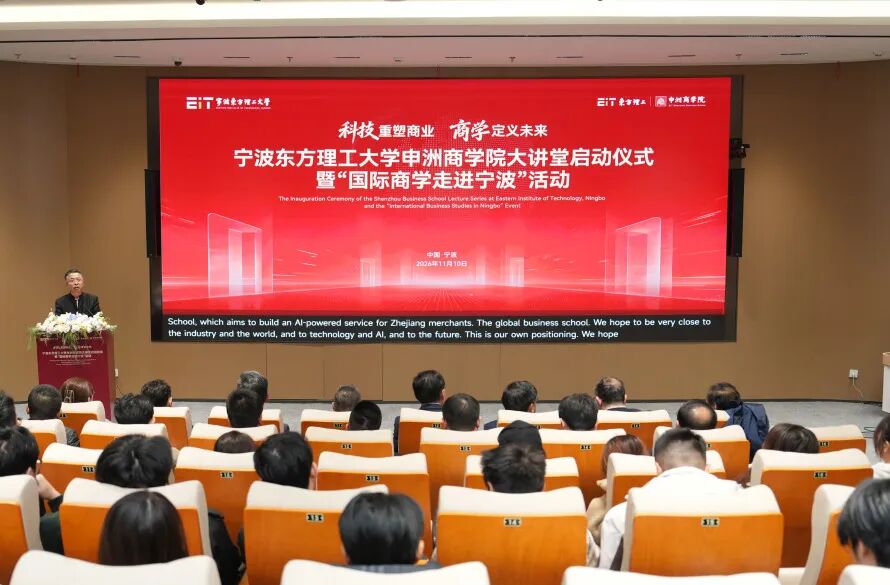
The event
Mr. JIN Bo, the Chairperson of EIT, joined other university leaders, along with representatives of business schools from universities across Ningbo, business leaders, and faculty and student representatives. The event was moderated by the Dean of Shenzhou Business School, BEN Shenglin.
A Two-Way “Coming to Ningbo”: Launching the Lecture Series Together
Prof. Ben introduced each of the university leaders, distinguished guests and representatives of business schools in Ningbo in turn, and welcomed the speakers and friends who had travelled from afar on behalf of the university.
Since its formal approval in June 2025, Prof. Ben noted, EIT has set out to nurture scientists with an entrepreneurial mindset, and cultivates innovators grounded in rigorous science for the AI era. The university already runs its own EIT Lecture Series; today, that that showcase now extends one step further to the wider public extends one step further, into business. Two stages, one purpose: to bring the best thinking to this campus and share it across Ningbo — and to put the wisdom of scientists and the instincts of entrepreneurs in the same room.
To applause from the assembled guests, Mr. HUA Jingdong, Mr. WU Wei and Prof. Kostas Nikolopoulos joined Mr. JIN Bo, Prof. ZHENG Chunmiao, Prof. HE Yiwu, Prof. ZHU Jingxu, Prof. DING Xuemei, Mr. YE Wenming, Prof. XI Chuanwu and Prof. BEN Shenglin on stage to launch the Shenzhou Business School Lecture Series.
Lecture One: Financial Innovation as a Spur to Sustainable Development
Mr. HUA Jingdong opened the series with Financial Innovation for Sustainable Development: A World Bank Perspective. Drawing on decades of multilateral finance at the World Bank, he began with the financing gap confronting global sustainable development and set out how financial innovation can mobilise long-term capital for the green transition, for climate governance and for emerging markets. Turning to the ISSB's push for global convergence on sustainability disclosure standards, he then examined how transparent information shapes the pricing of capital and the direction in which it flows.
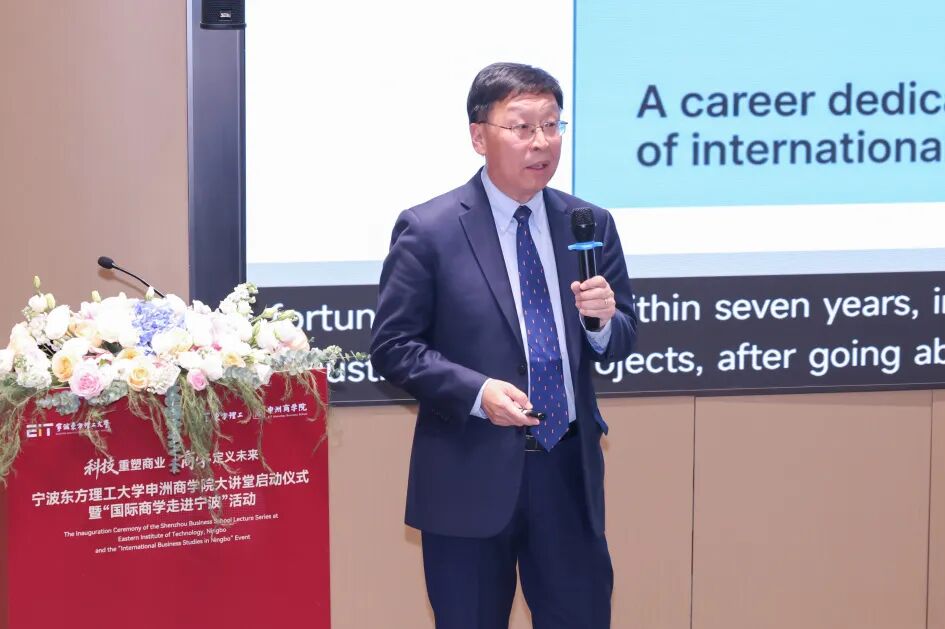
Mr. HUA Jingdong delivers address
Financial innovation is not an end in itself. The end is to move capital to where it is genuinely needed — to sustainable development, and beyond.
In his account, once sustainability is embedded in standards and instruments, capital for good ceases to be a vision and becomes something measurable and verifiable. Broad in scope and rich in case detail, the lecture deepened faculty and students' understanding of sustainable finance and of the international standards architecture around it.
Lecture Two: Making Sound Decisions in the Age of AI
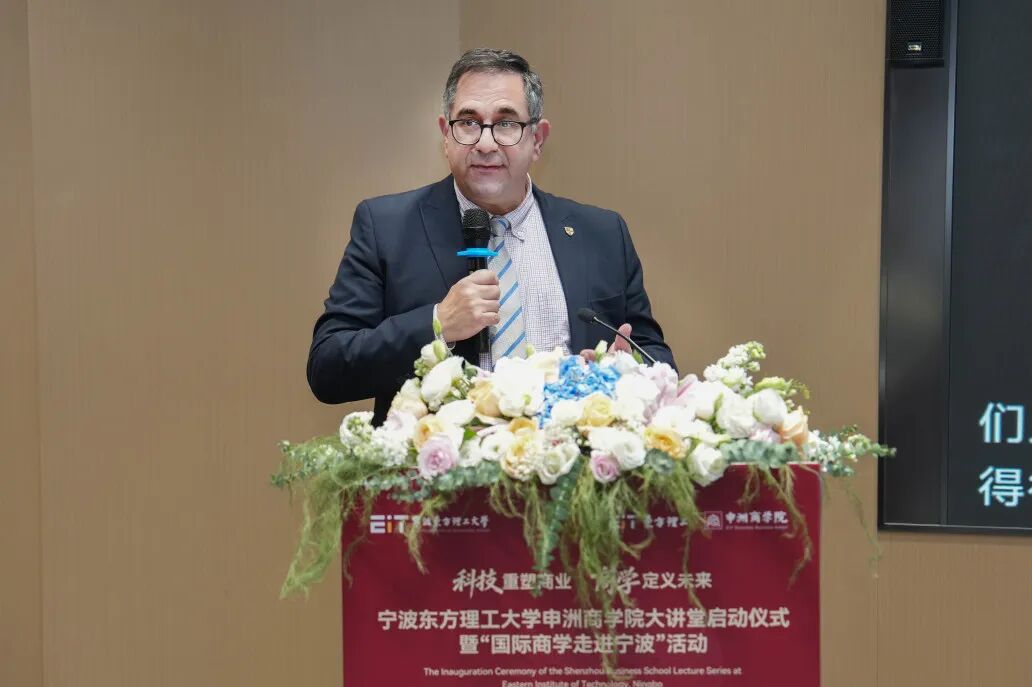
Prof. Kostas Nikolopoulos delivering his lecture
Prof. Kostas Nikolopoulos followed with Judgmental Forecasting, Herding Behaviour and Machine-Learning-Enhanced Consensus Forecasts, turning to the science of decision-making under uncertainty. He opened with the fundamental question of why forecasting is so difficult, noting that expert judgment carries real experiential value but is also prone to cognitive bias, while herding behaviour can push collective forecasts toward the crowd and amplify error. Machine learning, by contrast, can detect bias across vast archives of past forecasts and recalibrate dynamically, bringing the consensus closer to the truth.
Algorithms, in his view, are not there to replace human judgment but judge more clearly in an uncertain world. Delivered with clarity and wit, the lecture gave faculty and students a fresh lens on scientific decision-making in an age of human–machine collaboration.